Water scarcity is dangerously under-recognized as a global issue — UNESCO estimates that 1.8 billion people are living in countries or regions with absolute water scarcity, and two thirds of the global population are living under water stressed conditions. Climate change is increasingly exacerbating this crisis, yet water is also an issue where solutions exist.
As well as transforming domestically from a nation of desert to flourishing, modern cities, the UAE has long recognized the need for international collaboration to advance access to clean water. The late Sheikh Zayed bin Sultan Al Nahyan had a profound legacy in addressing water security, initiating the UAE’s transition from a desert to a rising international hub. Taking the UAE model, he commissioned more than 77,000 wells in more than 70 countries, which still benefit 50+ million people today. This legacy continues with projects such as Suqia, the UAE Water Aid Foundation, which is improving the lives of millions with water solutions in 37 countries, and the Mohamed bin Zayed Water Initiative, which is driving innovations through projects such as the XPRIZE Water Scarcity competition.
The UAE and the Republic of Senegal will co-host the 2026 UN Water Conference, set to be held in the UAE from 2-4 December 2026. The Conference will aim to accelerate progress in the implementation of SDG 6: Water and Sanitation and, after inclusive consultations with Member States, the themes of the Conference’s interactive dialogues will be:
– Water for people: the human rights to water and sanitation, including for those in vulnerable situations, for healthy societies and economies;
– Water for prosperity: valuing water, water-energy-food nexus, advancing integrated and sustainable water resource management, wastewater and water-use efficiency across sectors, and economic and social development;
– Water for planet: climate, biodiversity, desertification, environment, source to sea, resilience, and disaster risk reduction (DRR);
– Water for cooperation: transboundary and international water cooperation, including scientific cooperation and inclusive governance;
– Water in multilateral processes: SDG 6 (clean water and sanitation), the 2030 Agenda for Sustainable Development and beyond, and global water initiatives; and
– Investments for water: financing, technology and innovation, and capacity building.
The reality of climate change makes it imperative that the UAE invests in future sources of energy on a transformative scale and build global resiliency to address the changes already impacting the world.
As the host of the International Renewable Energy Agency (IRENA), Global Climate Finance Centre (GCFC), and Alterra, the world’s largest private climate investment fund, the UAE continues to gain prominence as a centre of innovation in climate technology, finance, and diplomacy. The UAE especially stands out as leader in energy transition — the share of oil and gas in GDP has declined from 90% in 1970 to below 25% today, while the UAE’s state-owned Masdar is one of the world’s fastest growing renewable energy companies.
The UAE ratified the Kyoto Protocol to the UN Convention on Climate Change in 2005 and it also quickly ratified the Paris Agreement of 2015. The UAE is seeking new energy alternatives and in October of 2021, announced the UAE Net Zero by 2050 Strategic Initiative, a national drive to achieve net-zero emissions by 2050, making the Emirates the first Middle East and North Africa (MENA) nation to do so.
The UAE is also helping others along the path to a more sustainable energy future. Abu Dhabi is home to IRENA, the first international organisation solely focused on encouraging the adoption of renewable energy. The $15 billion Masdar initiative is developing future energy sources and technologies, as well as investing in innovative ways to reduce water usage and improve energy efficiency, with projects in 40+ countries producing a combined capacity of more than 51GW. Masdar is the Middle East’s largest exporter of renewable energy, ensuring that the UAE’s research and capacity to deploy renewable energy at scale contributes to shared climate resiliency — especially with nations most vulnerable to climate change, such as Small Island Developing States.
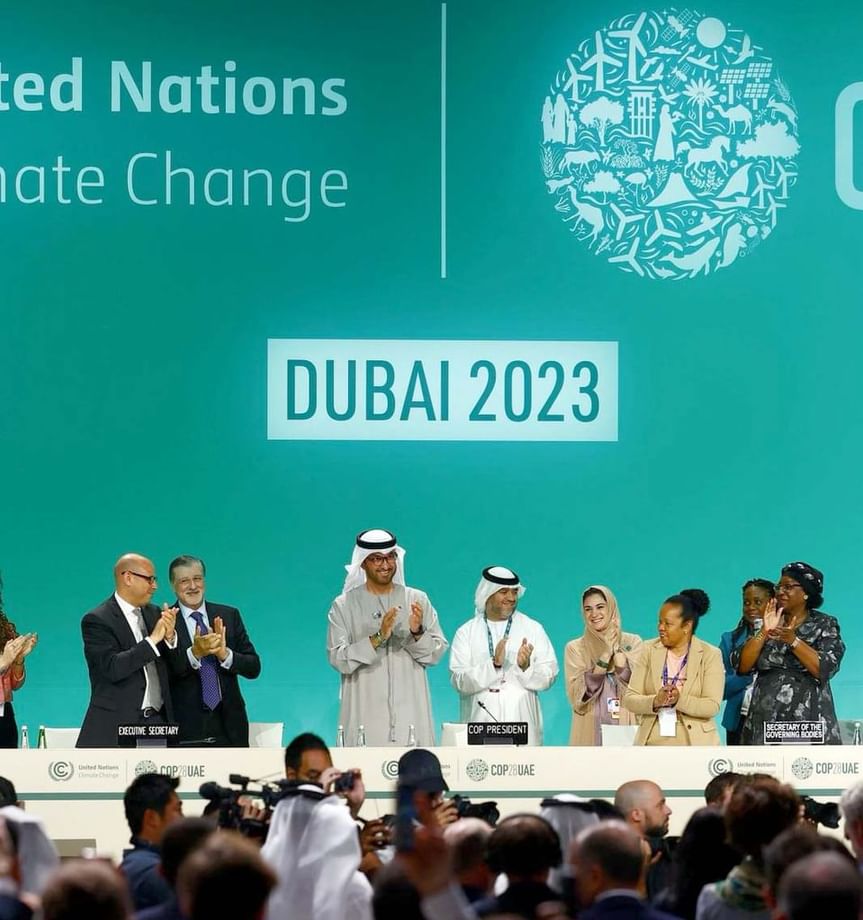
The UAE served as president of COP28 in 2023, with a commitment to practical solutions and inclusiveness. COP28 saw the adoption of the historic UAE Consensus by 198 countries, a landmark agreement to triple global renewable energy, double energy efficiency, and transition away from fossil fuels — this set the guiding path forward in global efforts to address the climate crisis. The outcomes further included significant breakthroughs on interconnected fields, with declarations on climate and peace, nature, health, food systems, oil and gas decarbonization, sub-national government action, inclusion of indigenous peoples, and the institutionalization of the Presidency Youth Climate Champion role.
COP28 also delivered the Emirates Framework for Global Climate Resilience, a global goal for climate adaptation, and the operationalisation of the Loss and Damage Fund for climate-impacted countries. Subsequent years have seen the UAE emerge as a hub for innovative climate finance: Abu Dhabi is now host to the Global Climate Finance Centre and Alterra, the world’s largest private climate investment fund.
Looking forward, the UAE will continue to emphasise its position that climate change is an all-encompassing issue, particularly addressing the interconnection of Climate, Peace and Security. As part of its partnership with the UN Climate Security Mechanism (CSM), the UAE co-chaired the Joint Steering Committee of the CSM in 2025 alongside Austria, as well as is supporting a Climate, Peace and Security Advisor in the UN Assistance Mission in Afghanistan (UNAMA).
The UAE is working domestically and around the world with the United Nations and its partners to achieve the 2030 Sustainable Development Goals (SDGs). Domestically, the UAE National Committee on SDGs, established in January 2017, mapped SDG targets to the UAE’s National Agenda, embedding SDG targets in the strategic plans of federal entities. The UAE’s foreign aid program also align with the SDGs, focusing on those people and regions where aid and assistance is most needed.
At the 2025 High-Level Political Forum on Sustainable Development, the UAE launched a first-of-its-kind exhibition at the UN Headquarters to share national achievements on the 2030 Agenda and drive momentum for a resilient, inclusive, and sustainable future. The UAE also initiated the XDGs 2045 concept — a visionary framework for advancing global development beyond 2030.

Stay up to date with what’s going on at the Mission by signing up for our email list below.
